"Looking for Sex?"
the naturist club sign that gets it right

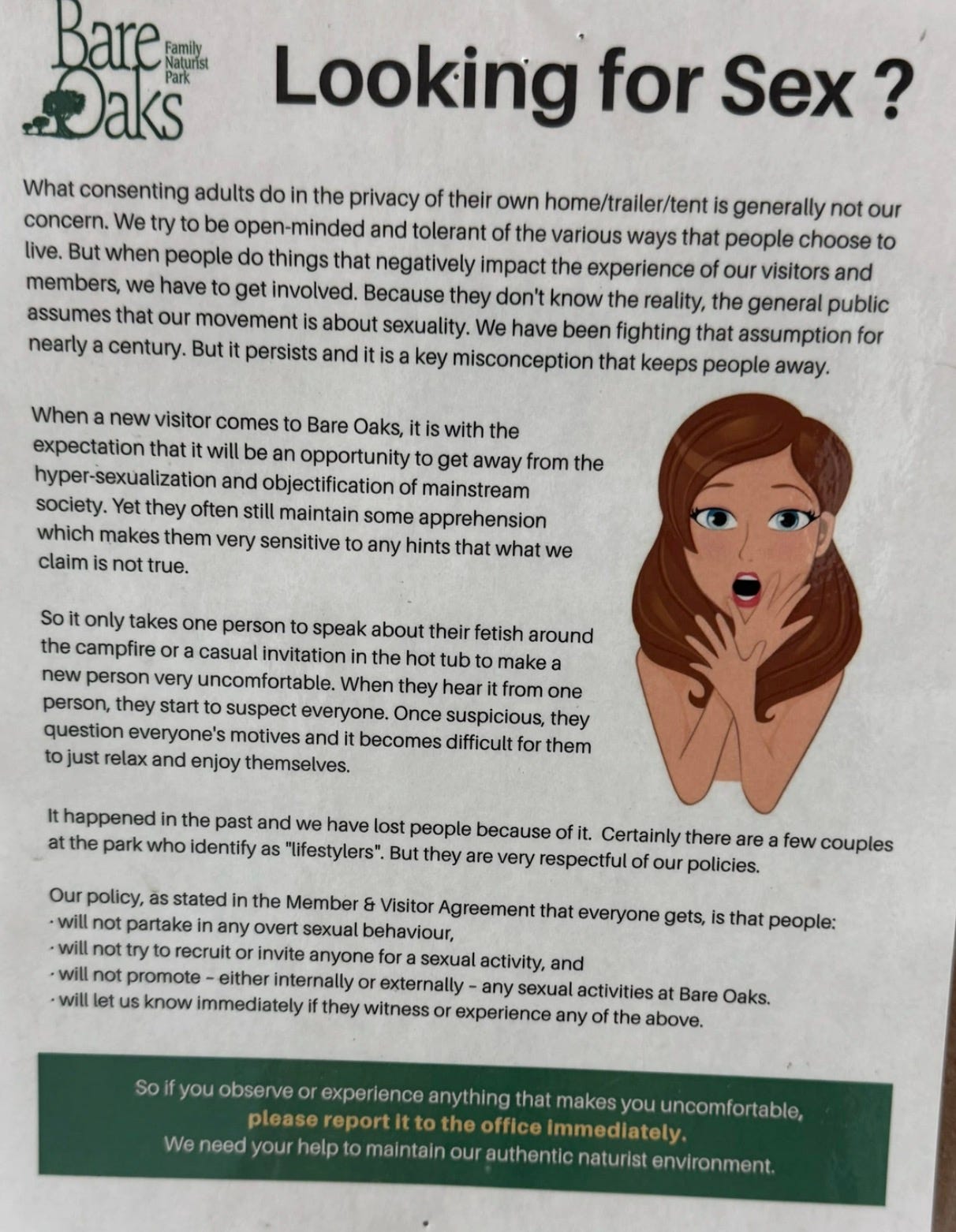
There’s a naturist park about an hour north of Toronto with a sign posted on the property. The headline, in big letters: “Looking for Sex?”
I laughed when I first saw it. Then I read the rest and stopped laughing, because Bare Oaks Family Naturist Park has done something on one laminated page that a lot of our community hasn’t managed in decades: they answered the question.
The question every club gets
Sooner or later, somebody asks it. At the front desk, on the tour, at the fire pit. “So... is swinging accepted here?”
I’ve heard a club leader answer it this way: “What happens in a private cabin is their own business.”
That sentence is true. Nobody disputes it. Consenting adults, privacy, all of it. But notice that it’s true the way “water is wet” is true. It doesn’t need to be said. I call it a truism answer, and the trouble with a truism answer is what it does in place of the answer you didn’t give. The person asked whether swinging is accepted at your club. You responded with a philosophy statement about privacy. What they heard was: yes, quietly, and we don’t look.
The problem isn’t the sentence. It’s the sentence as the whole answer.
And it fails two completely different people at once. Because there are two kinds of people who ask that question. One is a nervous newcomer who wants to hear that the answer is no. They’ve read the stereotypes, their friends made the jokes when they mentioned where they were going this weekend, and they are watching closely for any hint that the stereotype is the reality. The truism confirms their worst suspicion.
The other person asking is running a script. For them, the question is a probe, and the truism is a green light.
The swinger script, briefly
Gabby and I spent half of a recent podcast episode walking through a pattern we call the Swinger Script, so I’ll keep this short and point you to the episode for the full version.
It goes like this. Friendly small talk that name-drops lifestyle venues and watches how you react. A slide from naturist language, body freedom, openness, into sexual availability, as if one followed from the other. Then hospitality: come up to our place, we’ve got drinks. Then the proposition, framed as the natural next step of a journey you never agreed to take. Say no at the end and you get “but you seemed interested.”
The design feature is deniability. Every step, taken alone, is innocent. A travel story. An invitation. A misunderstanding. Report any single step and it sounds like nothing, which is why it almost never gets reported, which is why it keeps working. It targets newcomers, disproportionately women, and when it lands, the person usually just doesn’t come back. We lose them before they ever find out what this community is actually about.
The standard response, whenever this comes up, is that adults can just say no. On paper, sure. But the script is engineered so that no is expensive: you’re in someone else’s space, they have status and you don’t, leaving feels rude, and objecting makes you the prude who doesn’t get naturism. “Just say no” hands the entire enforcement burden to the person with the least power in the room.
Which brings me back to the sign.
What Bare Oaks got right
The sign quotes the park’s published Member and Visitor Agreement, and everyone who visits agrees to it. Four commitments:
will not partake in any overt sexual behaviour,
will not try to recruit or invite anyone for a sexual activity, and
will not promote – either internally or externally – any sexual activities at Bare Oaks.
will let us know immediately if they witness or experience any of the above.
Reads like boilerplate. It isn’t. There are four deliberate design choices in there, and each one is worth stealing.
It says the word. The headline is “Looking for Sex?” Not “conduct expectations,” not “a reminder about our values.” The sign does the awkward part once, in print, at the gate, so that no volunteer at the front desk ever has to improvise it again. When somebody asks the question now, the answer is a flat no, and the flat no is hanging on the wall. Nobody has to be the bad guy. They can point.
It bans the ask, not just the act. Look at the second commitment again: you will not recruit or invite anyone for sexual activity. That single line defeats the entire script. Nobody has to prove what would have happened at the cabin. Nobody has to establish that a boundary was crossed later. The invitation itself is the violation. All the deniability the script is built on, gone in nine words.
It draws the line at behavior, not identity. The sign says plainly that there are couples at the park who identify as lifestylers, and that they’re respectful of the policies. So this isn’t a purity test and nobody’s relationship structure is on trial. Swingers are welcome. The script is not. That distinction keeps the rule enforceable and keeps it from curdling into a panic about who people are instead of what they do.
It makes reporting everybody’s job. The fourth commitment isn’t addressed to victims. Everyone agrees to report what they witness, not just what they experience, and the sign closes with “we need your help.” On the episode I made the point that predators need gaps, and that a club where regulars fold newcomers in immediately is a club where the script can’t even get started. Bare Oaks wrote that into the agreement. Bystanders are the mechanism.
There’s one more thing on the sign, and it might be my favorite part because of how unflattering it is: “It happened in the past and we have lost people because of it.” No park is immune, including one that’s been fighting the naturism-equals-sex assumption for nearly a century. They learned it by losing people. The sign is what they built from the lesson.
The sign also names the real cost, and it’s sharper than the way I usually put it. It only takes one campfire comment, one hot tub invitation, and a new visitor doesn’t just distrust that one person. They start to suspect everyone. Once that happens they can’t relax, and relaxing was the entire reason they came. The damage was never just the proposition. It’s what the proposition does to every other interaction that weekend.
This should not be one park’s idea
Here’s what nags at me. Bare Oaks had to work this out alone, the hard way. So does every club, apparently. We have national and regional organizations in this movement, and guidance like this, a template policy, the reasoning behind it, training for the board and the front desk, is exactly the kind of thing they should be handing to every affiliated club as a matter of course. Not enforcement from above. Education. A starter kit for the conversation no club wants to have.
Until that exists, clubs can borrow. If your club has nothing posted, here’s a starting point you’re welcome to take, adapt, and put on a wall:
About sex at our club. What consenting adults do in private is their business. Here’s ours:
No sexual behaviour in shared or public spaces.
No inviting, recruiting, or propositioning anyone for sexual activity. The ask itself is the violation, and “they seemed interested” is not a defense.
Don’t present this club, to anyone, as a place to find sex.
If you experience or witness any of this, tell the office right away. You’ll be taken seriously, and you won’t be treated as the problem.
Notice the first line is the truism. It belongs there, as a preamble. It earns its keep when a flat no comes after it. That’s the whole difference between honesty and a wink.
Your body isn’t a debate. Neither is this.
Gabby and I go deeper on the Swinger Script, how each phase works and what to do in the moment, in the latest episode of The Naturist Vibe. Everything else we do lives here.
💯. Our club general manager needs to read this and implement this.
I like this and am saving this for my yard and gatherings!